
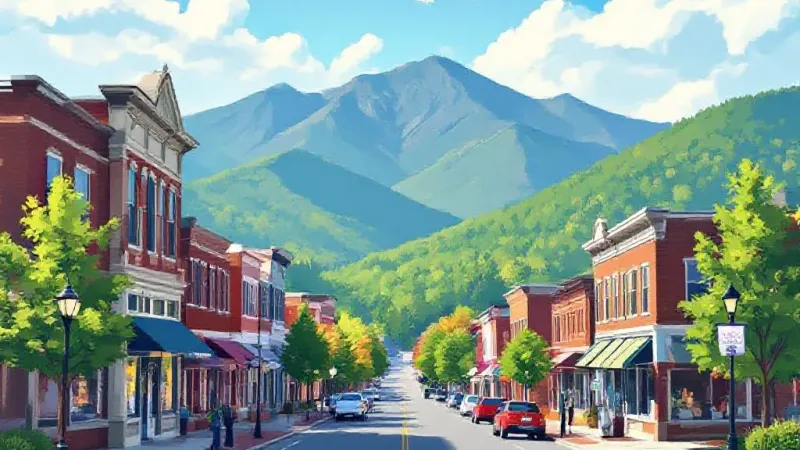
Boone, situated 3,333 feet up in the Blue Ridge Mountains, is distinguished as a premier college town, blending a walkable town center with immediate access to natural wilderness.
This unique combination, rare in America's largely car-centric landscape, defines Boone and the experience offered by Appalachian State University. The university, established in 1899 as the Watauga Academy, is positioned at the base of the Blue Ridge Mountains, at an elevation of 3,333 feet above sea level. This setting contributes to a landscape that draws potential students, with the environment often described as stunningly beautiful.
Seasonal changes vividly transform the area, with the trees surrounding the campus shifting into various shades of gold, red, and orange during autumn. In contrast, summer blankets the entire region in lush green. The town itself presents a picturesque scene, offering cultural and recreational opportunities for residents and visitors alike.
Key community attractions include the 1938 Appalachian Theatre, which now hosts classic movies and film festivals. The Jones House Cultural and Community Center, surrounded by foliage that changes color with the seasons, serves as a hub for live music concerts and various community events. For outdoor enthusiasts, the Greenway Trail provides opportunities for hiking, featuring picturesque bridges and dedicated picnic areas. Additionally, the Appalachian State University Nature Preserve allows for exploration of the region's largest contiguous forest, offering immersive experiences in the local ecosystem.
Boone exemplifies a type of college town that intentionally prioritizes pedestrian access and scenic integration. Such towns developed with downtowns that remain compact and easily navigable on foot, often with educational institutions situated in quiet, naturally beautiful locations, distinct from larger urban centers. This characteristic ensures that the beauty of the towns endures, regardless of student populations cycling through in four-year periods.
Across the country, other notable college towns share some of these qualities. San Luis Obispo, home to California Polytechnic State University, offers views of green hills and the sea. Wellesley, Massachusetts, features historic Wellesley Square, flanked by Morton Park and Church Park, along with the extensive grounds of Wellesley College near Lake Waban. In Burlington, Vermont, the University of Vermont's campus provides views of Lake Champlain and the Adirondack and Green Mountains, with easy access to downtown attractions like the Burlington Farmer's Market.
Further examples include Bryn Mawr, Pennsylvania, with Bryn Mawr College's historic Gothic architecture and surrounding arboretum, and Annapolis, Maryland, where St. John's College, one of the nation's oldest, features 18th-century buildings and colonial architecture along the Chesapeake Bay. Oxford, Mississippi, hosts the University of Mississippi, recognized for its campus beauty, including The Circle and The Grove, known for massive oak trees. Ohio University, in Athens, Ohio, sits along the Hocking River in the Appalachian foothills, with its campus transformed by cherry blossoms in spring and vibrant fall foliage.
Like Boone, Durango, Colorado, showcases its college within a stunning natural backdrop, with Fort Lewis College overlooking the Animas River Valley and linking directly to the town's downtown. Such locations underline the appeal of college towns that provide a balance of academic pursuit, outdoor recreation, and vibrant downtown activities, with natural beauty often just a short distance away.